Thanksgiving
Mom's Classic Thanksgiving Recipes and the Stories Behind Them
Classic Thanksgiving recipes and where they came from, from green bean casserole and cranberry sauce to stuffing and pumpkin pie, with make-ahead tips.

Green bean casserole was invented in a Campbell's test kitchen in 1955, and the marshmallows on the sweet potatoes first appeared in a 1917 booklet written to sell marshmallows. The other classic Thanksgiving recipes mom made every year, often from a card she could have recited with her eyes shut, have histories of their own: canned cranberry sauce goes back to 1912, and pumpkin pie to the colonies.
Below is each dish, where it came from, how to get it on the table without fighting over the oven, and, where a brand still publishes the original recipe, where to find it. The last section covers how to write down your own family's versions before they get lost.
Green bean casserole came out of a 1955 test kitchen
Green bean casserole has a named inventor. In 1955 Dorcas Reilly, a home economics supervisor at the Campbell's test kitchen in Camden, New Jersey, was asked to come up with a recipe for an Associated Press feature. She called it Green Bean Bake. As Smithsonian magazine told the story when she died in 2018, at 92, the dish took off once Campbell's started printing the recipe on its cream of mushroom soup cans. Her handwritten original card is now in the archives of the National Inventors Hall of Fame.
The version most families make is still very close to hers. Campbell's current recipe page lists five staple ingredients and bakes the casserole at 350°F, with half the fried onions stirred in and the rest scattered on top for the last few minutes so they stay crisp. The page also allows thawed frozen or canned beans if trimming fresh ones is more than you can face that week.
For hosting, the useful part is how little of it has to happen on the day. Trim fresh beans the day before, and keep the onions in their container until the dish goes into the oven. It needs about half an hour of oven time, which you can usually find while the turkey rests.
Sweet potato casserole and the marshmallow booklet
Sweet potatoes were on American tables long before anyone topped them with marshmallows. Amelia Simmons's American Cookery, published in 1796, already had recipes for them.
The marshmallow layer came from Angelus Marshmallows, which began selling mass-made marshmallows in 1907 and about ten years later wanted cooks to use them in everyday dishes. The company brought in Janet McKenzie Hill, the founder of the Boston Cooking School Magazine, to write the recipes. Her 1917 booklet contains what Smithsonian magazine reports as the first documented appearance of mashed sweet potatoes baked with a marshmallow topping.
Plenty of tables have split into camps: marshmallows, a brown sugar and pecan crumble, or half and half in the same dish to keep the peace. Whichever side your family is on, the sweet potato base can be made earlier in the day. The topping only needs a short time in a hot oven, and marshmallows go from golden to scorched quickly, so set a timer and stay close.
Cranberry sauce, from the can or from the pot
Cranberries are harvested from about mid-September to mid-November, which is part of the reason they ended up on the November table. In the early 1900s you could only buy them fresh for about two months of the year. In 1912 Marcus Urann, a lawyer who had left the law to buy a cranberry bog, started canning cranberry sauce at his packinghouse in Hanson, Massachusetts, so the berries could be sold all year. The jellied log that Ocean Spray still sells became available nationwide in 1941.
The can is still on plenty of tables. When Smithsonian magazine looked at the numbers in 2013, only about 26 percent of Americans made their own cranberry sauce for the holidays. If your family is split, put out both: the sliced log for the people who grew up on it, and a bowl of homemade sauce for everyone else.
If you make your own, it is the easiest dish on the menu to get out of the way early. It sets as it cools and is done before the oven is needed for anything, which leaves a burner free on the day for the gravy.
Stuffing or dressing, depending on where mom grew up
What you call it depends mostly on where you grew up. Mental Floss has traced the split: dressing is the usual word in southern states such as Mississippi, Tennessee, South Carolina and Georgia, stuffing is the word in Maine, New York and much of the North, and parts of Pennsylvania call it filling. People often say stuffing goes inside the bird and dressing is baked in a dish, but the name usually follows the region, not the method. In a lot of Southern kitchens it starts with cornbread instead of white bread.
Stuffing shows up in one of the earliest written descriptions of the Thanksgiving table. Sarah Josepha Hale, the magazine editor who campaigned for years until President Lincoln proclaimed a national Thanksgiving in 1863, wrote in her novel Northwood, as quoted by Plimoth Patuxet Museums, about a roast turkey "sending forth the rich odor of its savory stuffing."
The bread is the part to do early. Cube it and let it dry out a few days ahead, and chop the onion and celery the day before. If your family has always baked it inside the turkey, read the USDA's turkey roasting guide first. It says that for optimum safety, stuffing a turkey is not recommended, recommends cooking the stuffing outside the bird in a casserole for more even cooking, and lays out what to do if you stuff the bird anyway.
Mashed potatoes, gravy and the basket of rolls
Potatoes, gravy and bread were already on the table in the 1840s. The National Park Service reprints an 1845 Thanksgiving menu from The New England Economical Housekeeper that lists stuffed roast turkey, potatoes, gravy, apple and cranberry sauce, brown and white bread, and mince, pumpkin and apple pies. Next to the boiled chickens with cabbage, the chicken pie, the turnip sauce and the plum pudding that are also on it, the core of that menu would look familiar to most families now.
Mashed potatoes and gravy are the last-minute jobs. Both happen in the half hour while the turkey rests, which is exactly when the kitchen is fullest. Peel the potatoes in the morning, have the gravy pan and whisk out before the bird comes out, and give the masher to whoever asks if they can help.
Rolls are the dish most worth handing to a guest or buying from a good bakery. If rolls from scratch are the family tradition, bake them early in the day and warm them in the oven once the turkey is out.
Pumpkin pie got its modern recipe in 1796
Pumpkin pie is older than the country's cookbooks. A Library of Congress history of the pie notes that a Dutch colonist wrote in 1655 that the English colonists liked pumpkins "very much and use them also in pies." By 1796, Amelia Simmons's American Cookery, the first cookbook written by an American and published in America, had two recipes for "pompkin" pudding baked in a crust, with a custard filling of stewed pumpkin, eggs, sugar and cream or milk, spiced with ginger, mace and nutmeg. That is close to the pie most people still make. In Northwood, Hale gave the pumpkin pie "the most distinguished niche" on the table.
The recipe in most family files today is probably Libby's. The company says its Famous Pumpkin Pie has been printed on its canned pumpkin labels since 1950, so a pumpkin pie card that calls for evaporated milk may well have been copied from a can. Libby's own method ends with two hours of cooling on a wire rack, then serving immediately or refrigerating, which makes pumpkin pie the natural thing to bake the day before.
The turkey: let USDA do the math
We leave the turkey's numbers to the people whose job it is. The same USDA guide allows approximately 24 hours for every 4 to 5 pounds of frozen turkey in the refrigerator, at 40°F or below, and its chart gives a 16 to 20 pound bird 4 to 5 days. Thanksgiving 2026 is Thursday, November 26, so a bird that size moves from the freezer to the fridge the weekend before. Our free turkey chart sizes the bird by guest count (those numbers are ours) and copies USDA's fridge thawing and roasting times at 325°F onto one page you can print and stick on the fridge door.
On the day itself, the classics all want the oven. USDA's roasting tables use a 325°F oven for hours, the green bean casserole wants 350°F, and Libby's starts its pie at 425°F. The Hosting Checklist & Day-Of Timeline ($5) has an oven and stovetop schedule that lays the oven, a second oven, the stovetop, the microwave and the slow cooker side by side, so you see the clash on paper on Monday instead of at four o'clock on Thursday. It also has a four-week countdown dated from October 29, 2026. Our Thanksgiving Day timeline works the whole day backward from serving time, from the thaw day to the make-ahead jobs.
How to keep mom's classic Thanksgiving recipes for next year
The recipe that matters most may live on a stained index card or only in someone's head. This year, ask for it. Stand in the kitchen while she makes it and write down what she does that never made it onto the card: the extra onions, the particular dish, the splash of something she adds without measuring. Put her name and the year on it, and take a photo of the original card in her handwriting before it collects another gravy stain.
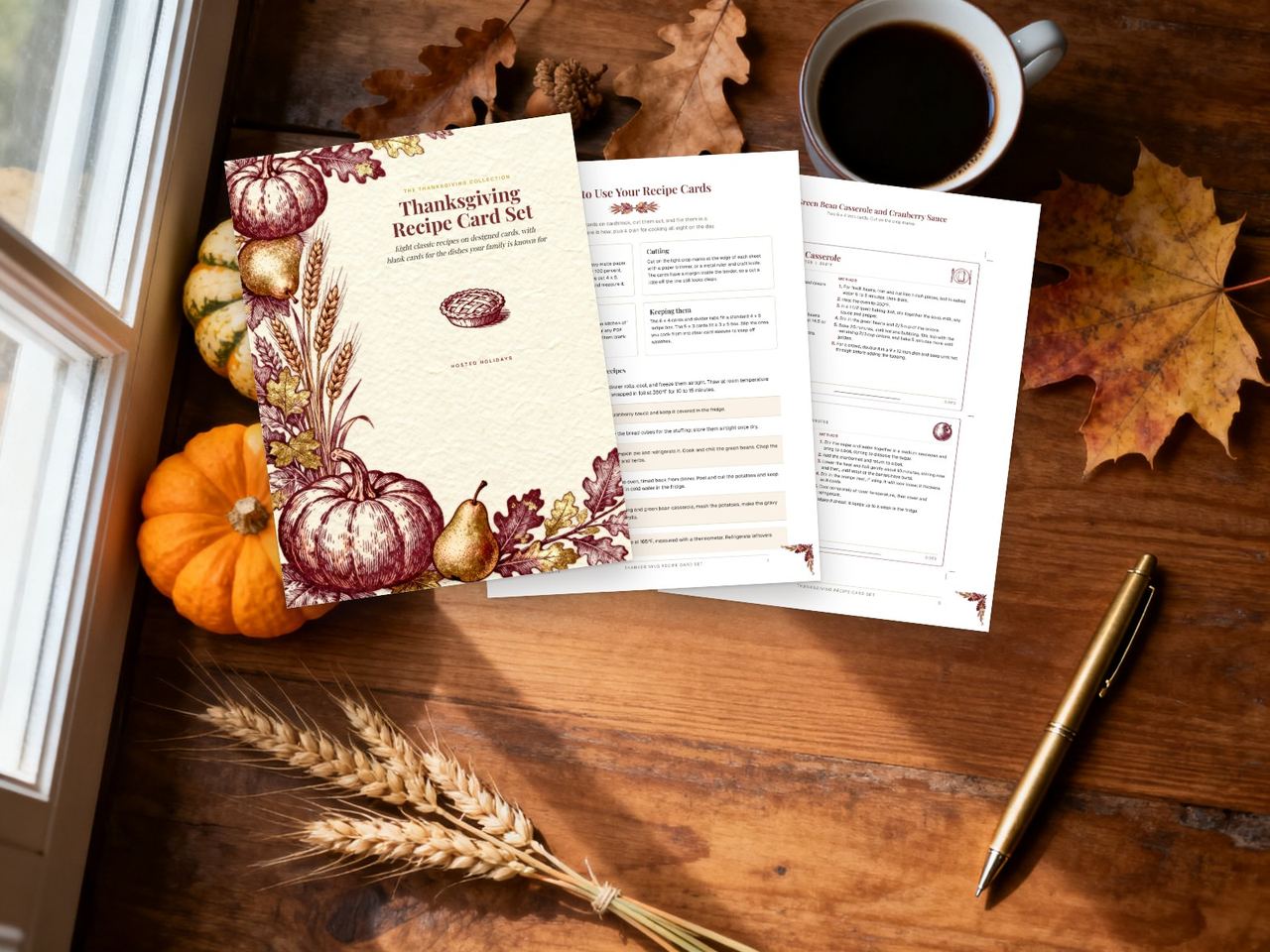
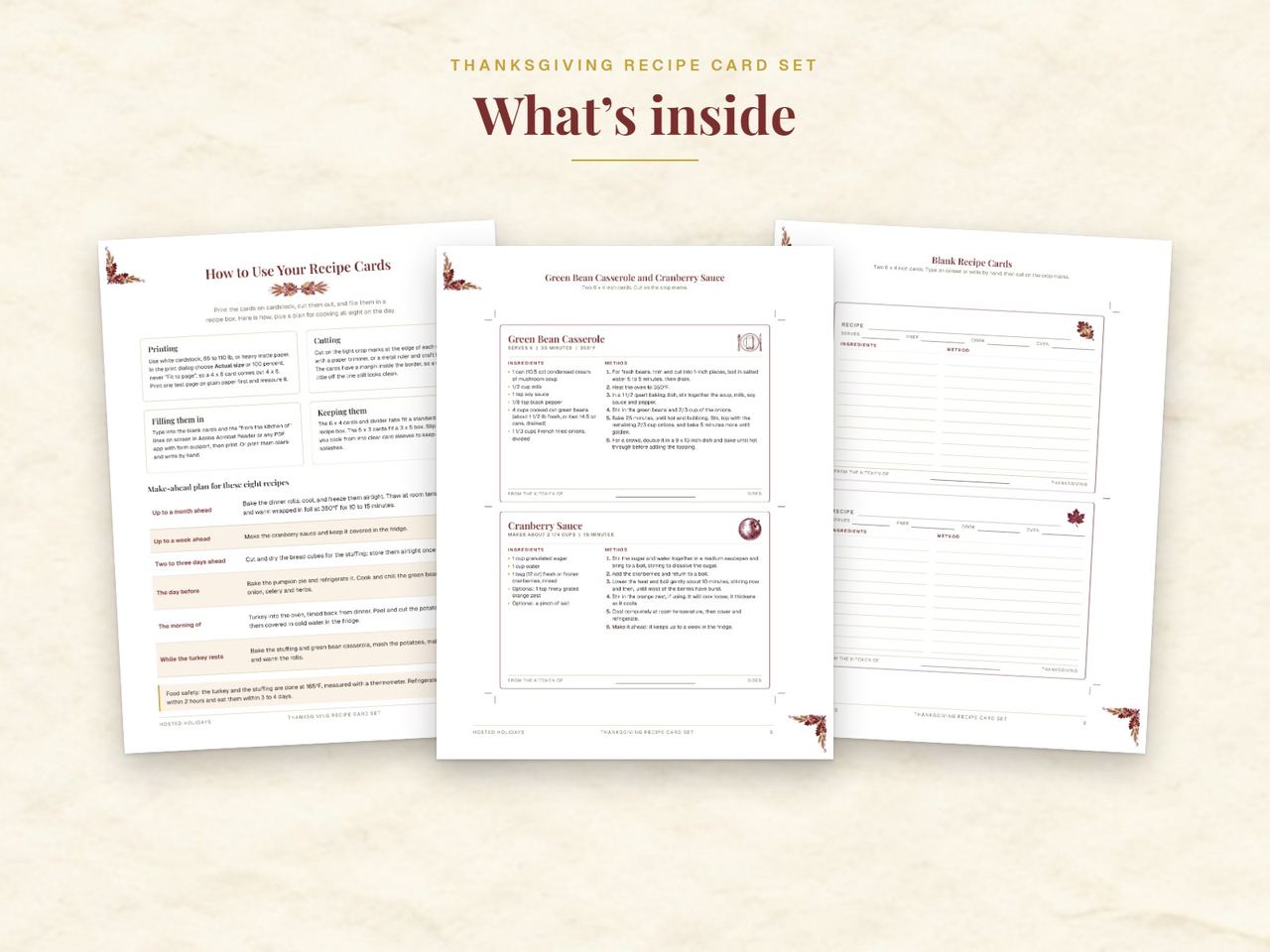
Then give it a home where it won't get lost. The Thanksgiving Recipe Card Set ($3) has blank fillable cards in 4 x 6 and 3 x 5, so you can type grandma's version on screen or write it by hand, plus eight classics already on cards, divider cards and a recipe index for the box.
Once the recipes are written down, they double as next year's menu. Lay the cards out on the counter two or three weeks before Thanksgiving and you can see which dishes need the oven, which can be made ahead and which ones a guest could bring. The Thanksgiving Hosting Planner ($5) has a menu page for exactly that, with a line per dish for who is making it, oven or stove, temperature and time, and a notes page for next year where the recipes worth keeping can go.
If this is your first year hosting, our guide to hosting Thanksgiving for the first time has a four-week plan that starts from that menu. If guests are bringing dishes, our Friendsgiving potluck guide explains how to run the sign-up by category, and the Friendsgiving Menu Template adds a potluck sign-up sheet. The Thanksgiving Grocery & Shopping List turns the finished menu into a list by store section with amounts for 8, 12 or 16 guests. All of them are in the Thanksgiving Collection, ten printables for $19.
Frequently asked questions
What are the most traditional Thanksgiving dishes?
Roast turkey with stuffing or dressing, mashed potatoes and gravy, cranberry sauce, sweet potatoes, green bean casserole, dinner rolls and pumpkin pie. Turkey, cranberries and pumpkin pie have been called Thanksgiving's menu trinity since the 1840s, according to the National Park Service. Green bean casserole is a 1955 addition.
Who invented green bean casserole?
Dorcas Reilly, a home economics supervisor in the Campbell's test kitchen in Camden, New Jersey. She created it in 1955 for an Associated Press feature and called it Green Bean Bake. It spread once Campbell's printed the recipe on its cream of mushroom soup cans, and her original recipe card went to the National Inventors Hall of Fame.
Why do people put marshmallows on sweet potatoes?
Angelus Marshmallows wanted cooks to use its product at home, so it hired Janet McKenzie Hill, founder of the Boston Cooking School Magazine, to write recipes for it. Her 1917 booklet has the first documented recipe for mashed sweet potatoes baked under a marshmallow topping, and the idea stuck.
What is the difference between stuffing and dressing?
Mostly geography. Southern states such as Georgia, Tennessee and Mississippi tend to say dressing, while Maine, New York and much of the North say stuffing, and parts of Pennsylvania say filling. People often say stuffing goes inside the bird and dressing is baked in a dish, but the name usually follows the region, not the method.
Why is cranberry sauce served at Thanksgiving?
Cranberries are harvested from about mid-September to mid-November, which is part of the reason they ended up on the November table. In 1912 Marcus Urann started canning cranberry sauce at his packinghouse in Hanson, Massachusetts, so the berries could be sold all year. The jellied log that Ocean Spray still sells became available nationwide in 1941.
When did pumpkin pie become a Thanksgiving dessert?
A Dutch colonist wrote in 1655 that the English colonists used pumpkins in pies, and Amelia Simmons's American Cookery printed two pumpkin puddings baked in a crust in 1796. Sarah Josepha Hale, who campaigned for a national Thanksgiving, gave the pie "the most distinguished niche" on the table in her novel Northwood, and an 1845 menu reprinted by the National Park Service lists it.
Printables from this post
Every one is a fillable PDF in US Letter and A4, with instant download.
-
Thanksgiving Recipe Card Set
Eight classic Thanksgiving recipes on cards made for a real recipe box
-
Thanksgiving Hosting Planner
Plan the menu, the guests and the turkey without the last-minute panic
-
Hosting Checklist & Day-Of Timeline
Four weeks of small jobs, then a calm and well-timed Thanksgiving Day
-
Thanksgiving Collection
All ten Thanksgiving printables, from the first invitation to the last slice of pie


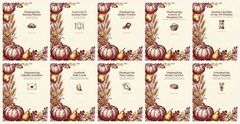 Get all ten Thanksgiving printables for $19One download, and you save $19 on buying them one by one.


