Thanksgiving
How to Seat Guests at Thanksgiving, From the Kids Table to the Uncle Who Debates
How to seat guests at Thanksgiving: where the host sits, couples, mixing two families, the kids table and tricky relatives, with a sample plan for twelve.

You have the guest list and the menu. Now comes the question of how to seat guests at Thanksgiving so that dinner works for everyone at the table, from the grandparents to a partner meeting the family for the first time to the relative who likes to argue about politics.
A seating plan is a short job once the replies are in. Thanksgiving 2026 is Thursday, November 26, so the plan itself can wait until mid-November. Count the furniture first, though, because the number of chairs limits every other choice.
Count the chairs before you place a single name
Start with the room. A common rule of thumb is about 24 inches of table edge per person, which means a long table seating five down each side and one at each end needs roughly 10 feet. If you are pushing two tables together, check that they are the same height before you commit to the layout.
Count adults and kids separately. Three children can usually squeeze in with their parents at the main table. Six usually cannot, and that is when a kids table becomes hard to avoid.
You need the final numbers before you can draw anything, so ask for replies by about Thursday, November 12, two weeks out. If you are sending invitations, the Thanksgiving Editable Invitation includes reply cards that ask for the number attending and dietary needs.
The host's seat, and who sits beside you
The Emily Post Institute's advice for official dinners was written for hosts seating diplomats and officials by rank, but the table geometry is the same at home. Traditionally, it says, the host and hostess sit at the head and foot of the table. Hosts who are friends with many of the guests may sit opposite each other in the middle instead, where it is easier to talk with more people.
Thanksgiving has one more factor: the person who cooked is going to get up, probably more than once. Whoever is in charge of the kitchen should take the end or corner seat closest to it, with a clear path out that does not involve four people tucking in their chairs. If there are two hosts, the other one takes the far end, so both halves of the table have someone keeping the conversation going and the dishes moving.
The seats either side of you are the ones to give away with thought. They suit a guest of honor, an older relative who might need a hand with the platters, or the person who feels least at home in the group. Before dinner, the Emily Post Institute's holiday hosting advice is to spend a little time with each guest, especially those who will not be seated near you.
How to seat guests at Thanksgiving when two families mix
The first year in-laws, step-families or two sets of grandparents share a table, it is tempting to let each family take one end. The two groups then spend the meal talking among themselves. Alternate the families down the table instead, so that every guest has at least one person from the other side within talking distance.
Couples need a decision too. Emily Post's advice on seating solo guests is to keep couples together at a table but not necessarily side by side, and to mix people who know each other with people who do not. For one family table we would apply it like this:
- Couples who have been coming for years can sit across from each other. They can still swap looks over the stuffing, and each of them talks to someone new.
- A partner meeting the family for the first time sits beside the person who brought them, and ideally across from your friendliest relative.
- A guest who came alone sits near people their own age, even if they have never met.
Then go through the list for practical needs. Anyone with a cane, a walker or a bad knee gets an end seat with a clear route to the bathroom. A relative who is hard of hearing does better in the middle of a side, next to someone who speaks clearly and away from the kitchen noise. Left-handed guests usually have more elbow room at the left end of a side. A guest with a food allergy should sit near the dishes they can eat, so they are not passing everything the length of the table and hoping no spoons wandered between bowls.
The kids table, and when to graduate from it
A kids table tends to work best with four or more children of roughly similar ages. One toddler and one 12-year-old at a table of their own are just two unhappy people, so in that case seat each child with a parent at the main table.
If you are setting one up:
- Keep it where the grown-ups can see it, and well away from the oven.
- Serve the kids first, so their parents can sit down and eat while the food is still warm.
- Give the table something to do between courses, such as craft paper over the top and a cup of crayons.
- Put an older cousin at the head as table captain. A 13-year-old who would sulk at being sent to the kids table will often enjoy running it.
When do kids move up? There is no fixed age, and every family seems to have its own rule. A simple one is that a child who asks to join the adults is ready to try. What we would avoid is sending an adult to the kids table because you ran out of chairs. Borrow a chair instead.
The kids' table page in the Guest List & Seating Chart has a six-seat diagram and a list for each child's age and the grown-up in charge. Once dinner is over, our list of Thanksgiving games for the whole family has ideas that work for the kids table and the grandparents at once.
Seating relatives who do not get along
Most families have at least one pairing that needs managing. Anthony Cawdron, an etiquette expert who teaches in Purdue University's hospitality school, offers a simple tactic in a Purdue interview on holiday table etiquette: if you have a particularly difficult uncle, seat him close to you, "so you can be near to control them a bit during the meal."
A few more placements help:
- Two people who clash sit on the same side of the table, several seats apart. Directly across from each other means two hours of eye contact over the turkey.
- Put your easiest talker between any two strong personalities.
- Spread the big talkers out, one in each section of the table, so the quiet end does not fall silent while the loud end holds a debate.
- Think about sensitive pairings as well as loud ones. Someone going through a hard year may prefer to sit near a relative they trust.
Seating will not prevent every argument, so plan for the conversation too. The Emily Post Institute notes in its holiday hosting advice that politics, religion, money and people's romantic lives were once considered "not table topics," and that when guests look bored or uncomfortable, it is up to the host to change the subject with a positive redirection. Some hosts keep a few question cards on the table for that moment, such as the Gratitude Table Cards ($3).
Place cards make the plan stick
Without place cards, people sit by habit: couples together, the loud cousins together, and Grandma wherever she was too polite to object. Cawdron recommends place cards, and notes that they also show guests you put thought into the meal.
Put them out when you set the table, a job our Thanksgiving day timeline moves to the days before Thanksgiving so Thursday is left for cooking. Write the names large enough to read from standing height, and use first names. If anyone quietly swaps two cards before dinner, let it go, and remember the swap when you plan next year.
A sample plan for a long table of twelve
Here is one way to seat twelve at a long table. Seat 1 is the head nearest the kitchen, seats 2 to 6 run down one side, seat 7 is the foot and seats 8 to 12 come back up the other side, so seats 2 and 12 are the two beside you. Swap in your own people.
- Seat 1, the head: you, the cook.
- Seat 2, beside you: your eldest guest, near enough for you to help with the platters.
- Seat 3: your most sociable relative, as a bridge between the end and the middle.
- Seats 4 and 5: one person from each family.
- Seat 6: the guest with a food allergy, near the dishes they can eat.
- Seat 7, the foot: your co-host, or a calm grandparent who can hold the far end.
- Seat 8: the relative who always argues with your uncle, on his side of the table but four seats away.
- Seats 9 and 10: the new partner, beside the person who brought them.
- Seat 11: your calmest, chattiest guest, as the buffer.
- Seat 12, beside you: the uncle himself, close enough for you to steer the conversation.
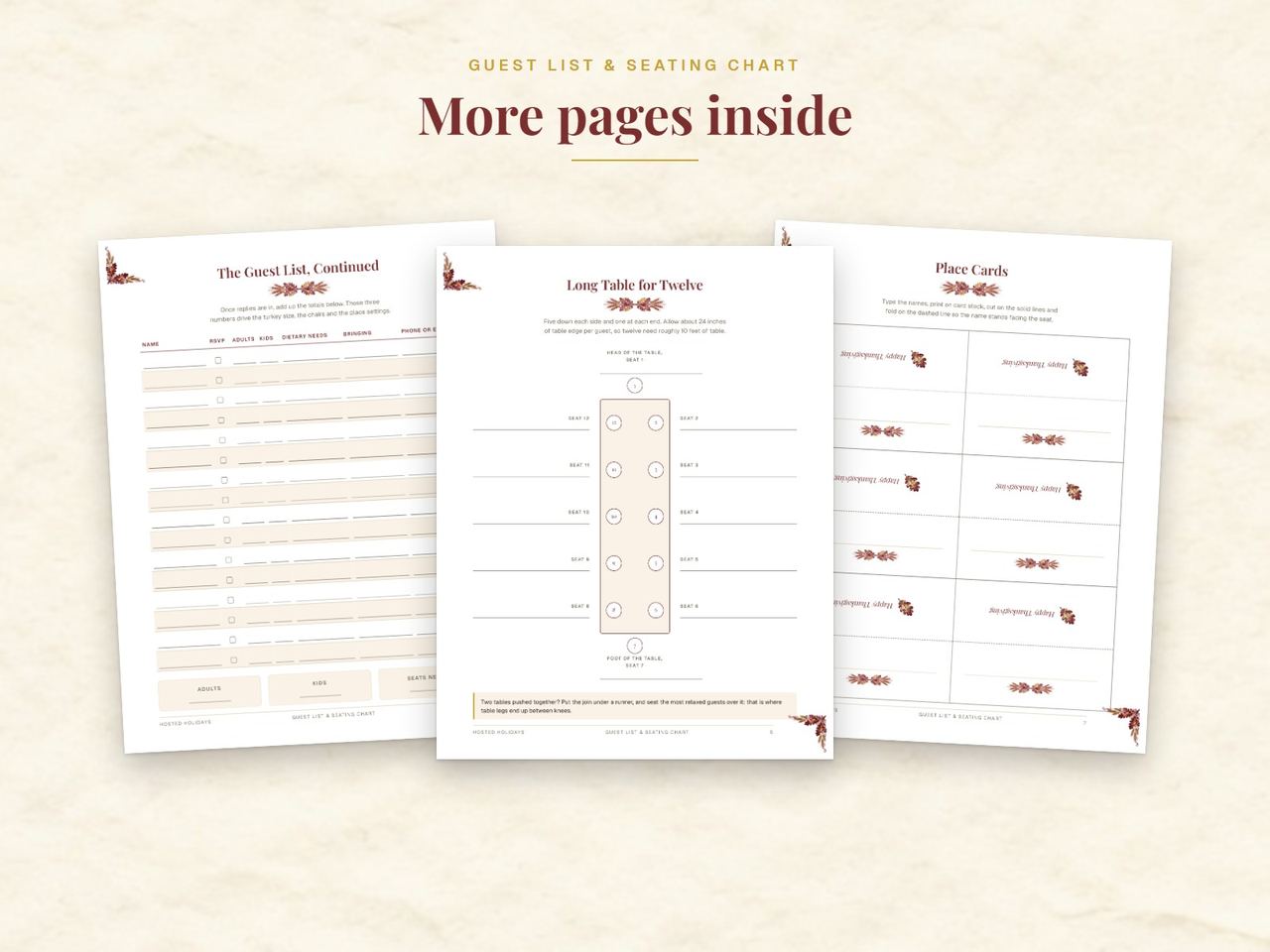
That numbering matches the long table diagram in the Guest List & Seating Chart, which also has fold-over place cards to print. If this is your first time hosting, our guide on how to host Thanksgiving for the first time puts the seating plan in week three of a four-week countdown.
The guest list, the seating charts, the invitations and the gratitude cards are all part of the Thanksgiving Collection, ten Thanksgiving printables in one download for $19.
Frequently asked questions
Where should the host sit at Thanksgiving dinner?
The person cooking should sit closest to the kitchen, ideally at an end or a corner, so they can check the oven or refill the gravy without making anyone stand up. For formal dinners, the Emily Post Institute describes the traditional layout as the hosts at the head and foot of the table, or opposite each other in the middle when they know many of the guests.
Should couples sit together at Thanksgiving?
Not necessarily. The Emily Post Institute says couples need not sit next to one another, and it recommends mixing people who know each other with people who do not. Longtime couples can sit across from each other so each talks to someone new. Someone meeting the family for the first time should sit beside the partner who brought them, at least for this year.
What age do kids move from the kids table to the adult table?
There is no set age, and every family has its own rule. A simple test is that a child who asks to join the adults is ready to try. An older cousin can also stay on as captain of the kids table, which lets a teenager feel in charge instead of left out. Just never send an adult there because you ran out of chairs.
Do you need place cards for Thanksgiving dinner?
For a family of six who eat together every week, no. For ten or more, or a table that mixes two families, place cards help a lot. Without them people sit by habit, couples cluster and the kids grab the end nearest the rolls. Purdue etiquette expert Anthony Cawdron recommends them, and says they show guests you put thought into the meal.
How do you seat family members who do not get along?
Put them on the same side of the table several seats apart, with a calm, chatty guest between them, so they are never face to face across the turkey. If one person tends to stir things up, seat them near you, as Purdue's Anthony Cawdron suggests, so you can steer the conversation when it drifts.
Printables from this post
Every one is a fillable PDF in US Letter and A4, with instant download.
-
Guest List & Seating Chart
Know who is coming, what they can eat, and exactly where they sit
-
Gratitude Table Cards
Thirty-six questions that get the whole table talking about what matters
-
Thanksgiving Editable Invitation
Type your details, print or text them, and the invitations are done
-
Thanksgiving Collection
All ten Thanksgiving printables, from the first invitation to the last slice of pie


 Get all ten Thanksgiving printables for $19One download, and you save $19 on buying them one by one.
More from the blog
All posts-
Thanksgiving
Thanksgiving Dinner on a Budget: What It Costs and Where to Save
-
Thanksgiving
Mom's Classic Thanksgiving Recipes and the Stories Behind Them
-
Thanksgiving
How to Host a Friendsgiving Potluck


