Christmas
The History of Christmas Traditions We Still Host at Home, From Advent to Christmas Eve
The history of Christmas traditions we host at home: Advent calendars, stockings, the first card, cookie swaps and gift wrap, and how to start each one.

Most of what we do in December feels ancient, yet the history of Christmas traditions that people host at home today reaches back to the 1800s, with a few later additions. Several began as someone's practical fix, like a London civil servant with a pile of unanswered letters, or a Kansas City shop that ran out of tissue paper one December.
Six of them follow, each with a way to bring it home this year: Advent calendars, stockings, cards, cookie swaps, wrapped presents and Christmas Eve.
A short history of Christmas traditions at home
The Christmas most of us host, built around children, presents and a family dinner, took shape in the 19th century. The Library of Congress points out that Christmas trees were not really a thing in the United States until the 1840s, and that Christmas only became a federal holiday in 1870, when President Grant made it one partly to give the North and South something peaceful to share after the Civil War.
In Britain the 1840s brought Prince Albert's German customs, including the decorated tree, and in 1843 Charles Dickens published A Christmas Carol. That same December in London, the first Christmas card went to the printer.
Advent calendars: from chalk marks to little doors
Advent is the church season before Christmas. The calendar that counts it down is a German idea from the 1800s. According to Britannica's history of the Advent calendar, German Protestants marked the days by lighting a candle, laying a straw in a Nativity crib, chalking a line on a wall or door, or hanging up a small devotional picture.
The best-known origin story belongs to Gerhard Lang. When he was a boy in the late 1800s, his mother sewed 24 small cookies, or 24 pictures depending on who tells it, onto a piece of cardboard, and he could take one each day. He grew up to be a Munich publisher.
The date of his first calendar depends on whom you ask. An Advent calendar exhibition at Germany's Kunstsammlungen Chemnitz gives 1903, and notes that a Hamburg bookshop had already printed a "Christmas clock" for children in 1902. National Geographic and Britain's National Trust both say 1908. Britannica credits Lang with adding the little doors in the 1920s, and chocolate behind the doors seems to have arrived in the 1950s. The German calendars counted down to Christmas Eve, the evening the children opened their presents, and most calendars still stop at the 24th.
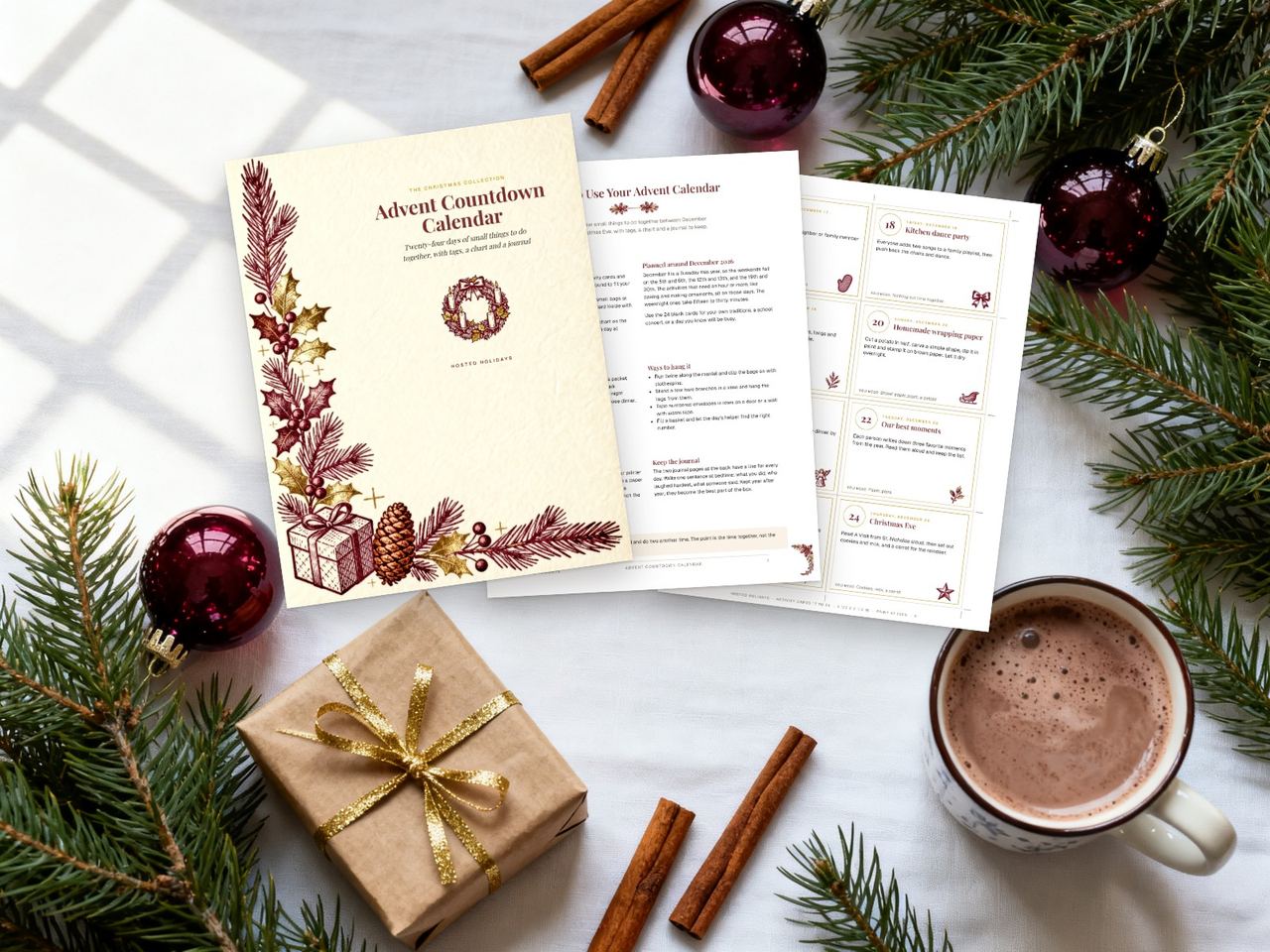
The homemade idea of one small thing a day is easy to copy. Our Advent Countdown Calendar ($5) uses activities in place of treats: one for each day of December 2026, like paper snowflakes or a walk to see the lights, with the longer ones placed on weekends.
Christmas stockings: a legend, a poem and an orange
Nobody knows exactly how stockings started, and the story usually told is a legend. St. Nicholas was a real bishop in what is now Turkey, remembered for being kind to children, with a feast day on December 6. In the tale, a poor widower cannot afford dowries for his three daughters, so Nicholas secretly drops gold down the chimney at night and it lands in the girls' stockings, which are drying by the fire. In some versions he throws bags of gold through a window instead. Smithsonian magazine calls the story far-fetched and notes that its origin and date are unknown.
The written record is younger. Dutch children set out their shoes on the eve of St. Nicholas Day, and in 1809 Washington Irving's satirical History of New York mentioned the "pious ceremony" of hanging up a stocking in the chimney on St. Nicholas Eve. Then, on December 23, 1823, the Troy Sentinel in New York printed an unsigned poem that began "'Twas the night before Christmas" and included the line "The stockings were hung by the chimney with care." Clement Clarke Moore later claimed it, though the family of Henry Livingston Jr. argued he was the real author, and some scholars still agree with them.
Smithsonian gives two explanations for the orange in the toe: fresh fruit was once a rare winter treat, or the orange stands in for the three gold balls of another version of the legend. For the rest of the stocking, the Stocking Stuffer Checklist ($3) sorts ideas by age, from young kids to grandparents and pets, and gives each stocking a card for what you have already bought.
The first Christmas card, 1843
Henry Cole, a London civil servant who helped set up Britain's Penny Post and later became the first director of what is now the V&A, had a pile of unanswered Christmas letters in 1843. He asked his friend, the painter John Callcott Horsley, to design a card he could send instead. Cole's diary for December 17 reads, "In the Evg Horsley came & brought his design for Christmas Cards."
The V&A's account of the first Christmas card describes the design: three generations of the Cole family raising a toast in the middle, with scenes of giving on either side. Cole had 1,000 printed and offered the spares for sale at a shilling each. The children drinking wine in the picture upset some people at a time when the temperance movement was growing.
Whether the card sold well depends on the museum. The V&A says it was judged a commercial flop, while London's Postal Museum says the controversy did not stop people buying it and more were printed to meet demand.
Louis Prang, a Prussian-born printer near Boston, is credited with the first Christmas card made in the United States, in 1875. Smithsonian magazine notes that it showed a flower, with no Christmas scene, and simply read "Merry Christmas."
Most of the work of sending cards today is the address list, which tends to get rebuilt each December from old envelopes and memory. The Christmas Card & Address Tracker ($5) keeps one line per household for three Christmases, with a box to check each year you send.
Cookie exchanges: a swap from the 20th century
Christmas cookies are much older than the swap. Amelia Simmons's American Cookery of 1796 already had a recipe called "Another Christmas Cookey," and cut-out shapes spread in the late 1800s, when cheap tin cookie cutters arrived from Germany.
Newspaper mentions of "cookie exchanges" go back to at least 1917, though food historian Lynne Olver of the Food Timeline found that some early ones may have been fundraising bake sales. Christmas cookie swaps turn up in newspapers by the early 1950s, and in November 1960 the Los Angeles Times called the swap a rising trend "from coast to coast." Its example was Mrs. Robert Blanch of Minneapolis, whose bridge club had held one three years running: each of the eight members baked one kind of cookie, a dozen for every member. By 1963 Betty Crocker's Cooky Book called the Christmas cooky swap "a popular once-a-year party."
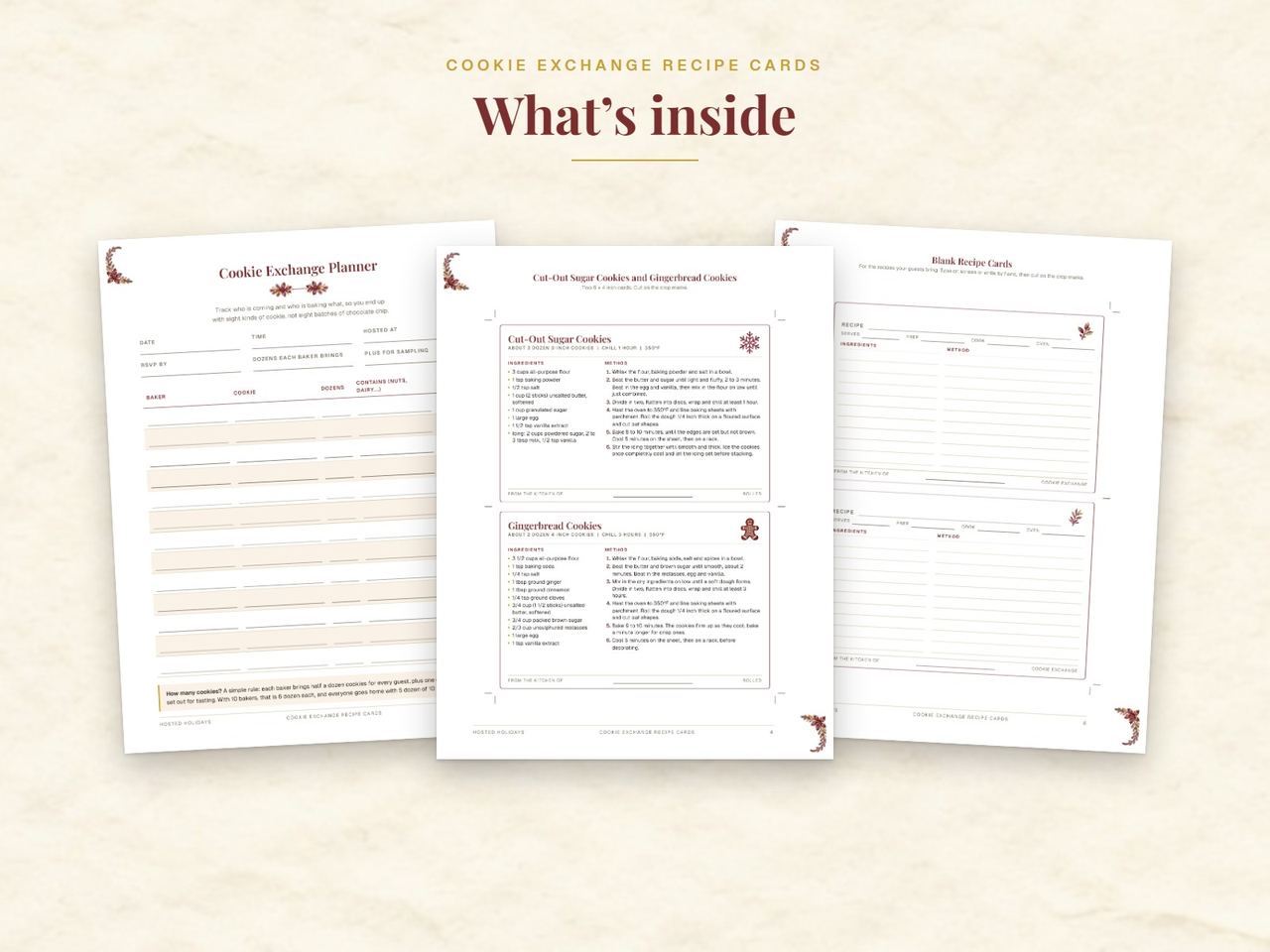
Settle who is baking what before anyone turns on an oven. The planner in our Cookie Exchange Recipe Cards ($3) has room for 13 bakers, so you get eight kinds of cookie instead of eight batches of the same one. Eight recipe cards and container labels with allergen checkboxes come in the same download.
Gift wrapping: the year the tissue paper ran out
Hallmark's company historian describes early 1900s "gift dressing" as brown packaging paper or newspaper, with shops selling plain tissue in red, green or white.
By the company's own account, at Christmas 1917 the Hall brothers' store in Kansas City sold out of tissue paper. Rollie Hall went to the company's plant, found a stock of brightly patterned envelope liners imported from France, and put them out at 10 cents a sheet. They sold out. The next year the store stocked up and sold out again, and the brothers soon began designing and printing their own wrapping paper.
A century later, the tags are the fiddly part. Our Wrapping Station Labels & Gift Tags ($3) let you type every To and From before you print, with a separate From Santa design so your handwriting stays out of it.
Christmas Eve: the night the traditions meet
Several of these stories end on the same evening. According to Columbia Magazine, on Christmas Eve 1822 Clement Clarke Moore was hosting a holiday gathering at his house in Manhattan when he read out a light poem he had written as a present for his six children. In it, St. Nicholas arrives on Christmas Eve instead of December 5, the eve of his feast day, when Dutch children set out their shoes.
So a Christmas Eve at home can hold most of this post: stockings hung after dinner, a plate of cookies from the swap, the poem read aloud and the last day of the countdown. It can also mean a dinner, a brunch the next morning and one oven for both. The Christmas Eve/Day Party Planner & Schedule ($5) plans both days hour by hour, with an oven schedule in half-hour slots, so you know what goes in when.
Trying several of these traditions in one December takes some planning. The Master Christmas Planner ($5) has a traditions and activities page with 11 ideas to plan and check off, and a December 2026 calendar with room to write in every day. The Christmas Collection has all ten of our Christmas printables in one download, including every one in this post, for $19 against $40 bought separately.
Frequently asked questions
Who sent the first Christmas card?
Henry Cole, a London civil servant who later became the first director of the Victoria and Albert Museum, commissioned the first commercial Christmas card in 1843. His friend John Callcott Horsley designed it: a family raising a toast between two scenes of charity. Cole had 1,000 printed, used what he needed and offered the rest for sale at a shilling each.
Where did the tradition of hanging Christmas stockings come from?
Nobody knows for certain. The popular story says St. Nicholas dropped gold into stockings drying by a poor family's fire, but it is a legend of unknown date. The written record starts later: Washington Irving mentioned hanging a stocking on St. Nicholas Eve in 1809, and the 1823 poem A Visit from St. Nicholas put the stockings by the chimney on Christmas Eve.
When was the first Advent calendar made?
Printed Advent calendars appeared in Germany in the early 1900s. Munich publisher Gerhard Lang is usually credited, with sources giving 1903 or 1908, and a Hamburg bookshop printed a Christmas clock for children in 1902. Before that, German families counted the days with chalk marks on a door or a candle a day. Little doors came in the 1920s, chocolate in the 1950s.
When did Christmas cookie exchanges start?
Newspapers mention cookie exchanges from at least 1917, though some early ones may have been bake sales. In November 1960 the Los Angeles Times called the Christmas cookie swap a rising trend, and Betty Crocker's Cooky Book of 1963 described a popular once-a-year party where each guest brings a dozen of her holiday specialty for every woman there.
When did people start using wrapping paper for Christmas presents?
In the early 1900s most presents went out in brown paper, newspaper or plain tissue in red, green or white. By Hallmark's account, decorated gift wrap began at Christmas 1917, when the Hall brothers' Kansas City store ran out of tissue and sold French envelope liners at 10 cents a sheet. They sold out two years running, and the brothers began printing their own.
Printables from this post
Every one is a fillable PDF in US Letter and A4, with instant download.
-
Advent Countdown Calendar
Twenty-four small things to do together, from December 1 to Christmas Eve
-
Christmas Card & Address Tracker
Every address and every card sent and received, for three Christmases
-
Cookie Exchange Recipe Cards
Eight classic cookie recipes and everything to host the swap
-
Christmas Collection
All ten Christmas printables: the plan, the gifts, the cards, the party and the kids


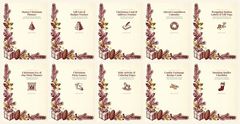 Get all ten Christmas printables for $19One download, and you save $21 on buying them one by one.


